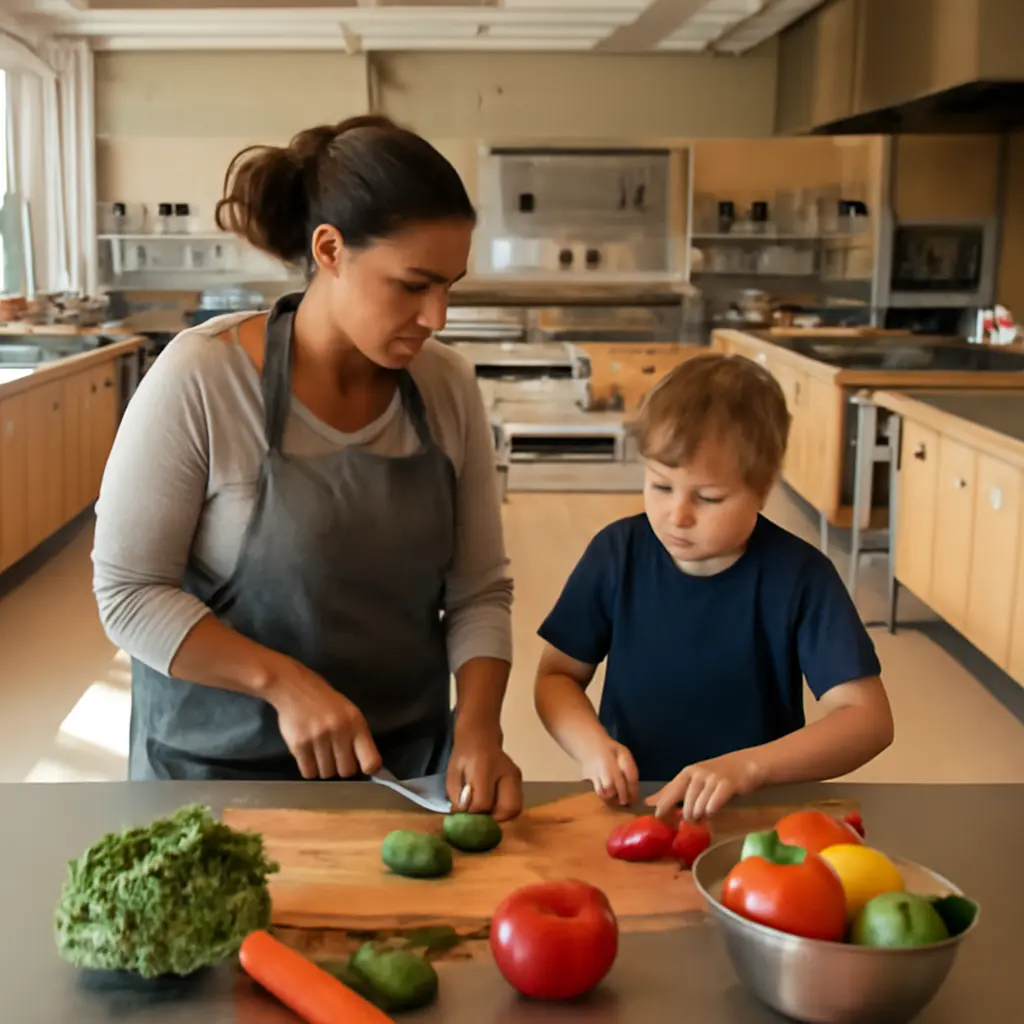
Schools are increasingly inviting families into the kitchen through hands-on food and nutrition programs that teach parents and children to prepare healthier meals together. These programs combine cooking skills, nutrition education, and practical family routines; they matter because diet quality in childhood is linked to long-term health, while many families face cost, time, and access barriers to nutritious food. Evidence supports cooking education as a promising way to build confidence and food skills, though results depend on program design and access to ingredients. The sections below explain what school-based family cooking education involves, how programs work, what research can—and cannot—show, and how schools can make the lessons useful beyond the classroom.
School-Based Family Cooking Education: What It Means and Why It Matters
School-based family cooking education is a set of lessons or events in which students and caregivers learn food preparation and nutrition together, often using recipes, demonstrations, and guided practice. The U.S. Department of Agriculture’s Team Nutrition initiative describes school nutrition education as a way to help students make informed food choices and connect classroom learning with meals and the school food environment. Family cooking programs extend that approach by including caregivers, who influence what foods are purchased, prepared, and served at home.
The need is substantial. The Centers for Disease Control and Prevention reported that 21.1% of U.S. children and adolescents ages 2–19 had obesity in 2021–2023. That statistic does not mean cooking classes alone can prevent obesity: health is shaped by income, food availability, culture, marketing, time, and many other factors. But practical instruction can help families develop skills for preparing affordable, balanced meals and for making confident choices in varied food environments.
The phrase “teaching parents how to cook” should not imply that caregivers lack knowledge or that there is one correct cuisine. Strong programs treat families as partners, recognize existing food traditions, and focus on adaptable techniques—such as safely preparing vegetables, using beans and whole grains, or modifying a recipe to fit a budget and household preferences.
Family cooking workshops
A family cooking workshop is a supervised session where adults and children prepare a meal or snack together. Participants may practice knife safety, measuring, cooking methods, food hygiene, and reading recipes while discussing nutrition. Unlike a lecture, the workshop lets families learn by doing and gives children a meaningful role in meal preparation.
Nutrition education connected to school meals
Nutrition education connected to school meals links lessons to foods students encounter in cafeterias, gardens, or classroom activities. USDA Team Nutrition resources support schools with materials on nutrition, food skills, and healthy school environments. When family events use familiar school-meal ingredients or recipes, caregivers can see how the same foods might be prepared at home, while schools can learn which flavors and formats appeal to their communities.
Food safety and kitchen confidence
Food safety is an essential part of cooking education, not an optional add-on. The CDC identifies four basic practices for preventing foodborne illness: clean, separate, cook, and chill. Family lessons can demonstrate handwashing, keeping raw foods apart from ready-to-eat ingredients, using a food thermometer, and refrigerating perishable foods promptly. These practices make cooking safer while helping participants become more comfortable preparing meals.
How Family Cooking Programs Build Skills and Support Health
A useful way to assess a program is to separate what participants learn from the conditions that help them use it. Cooking knowledge includes understanding ingredients and techniques; food skills include planning, shopping, preparing, and safely storing meals. The Journal of Nutrition Education and Behavior has published research on cooking and food-skills interventions, reflecting growing interest in how practical instruction can influence confidence and food choices. Reviews generally suggest benefits for cooking confidence and related skills, while also noting that study methods and outcomes vary.
This distinction matters: a family may learn how to prepare a vegetable-rich dish but still lack affordable ingredients, working kitchen equipment, or time to make it regularly. Effective school programs therefore pair instruction with realistic recipes, ingredient access, and take-home guidance. The following program features show how education can move from a one-time activity toward lasting household practice.
Hands-on practice and age-appropriate roles
Hands-on practice means participants actively prepare food rather than only watching a demonstration. Children can wash produce, tear greens, measure ingredients, or stir mixtures, while adults supervise tasks involving heat and sharp tools. The National Heart, Lung, and Blood Institute’s We Can! resources encourage family involvement in healthy eating and activity. Shared tasks can make children more familiar with new foods and help caregivers turn a recipe into a repeatable family routine.
Affordable recipes and food access
Affordable cooking education uses ingredients and methods that fit local prices, storage options, and available equipment. The USDA’s Thrifty Food Plan provides the basis for the maximum monthly allotments in the Supplemental Nutrition Assistance Program and is designed to represent a nutritious, low-cost diet. Schools can apply the underlying practical lesson by showing how staples such as beans, lentils, eggs, frozen vegetables, and whole grains can be combined in flexible meals—while avoiding the assumption that every household has the same budget or access to shops.
The U.S. Department of Agriculture’s Household Food Security report documented that 13.5% of U.S. households experienced food insecurity at some point in 2023. Cooking instruction cannot resolve food insecurity by itself. Programs are more equitable when they offer ingredients to take home, connect families with school meal services and community food resources, and avoid requiring participants to purchase specialty equipment or costly items.
Culturally responsive recipes and family knowledge
Culturally responsive cooking education includes recipes, ingredients, languages, and food traditions that reflect the families a school serves. It invites caregivers to share techniques and adapt dishes rather than treating familiar foods as obstacles to healthier eating. For example, a class might discuss adding vegetables to a family’s customary soup, using lower-sodium seasonings, or preparing a traditional grain with beans. This approach respects cultural identity and makes nutrition guidance more practical and relevant.
Evidence, Examples, and Ways Schools Can Improve Programs
Program success should be measured by more than attendance or the number of recipes distributed. Schools can assess whether participants feel more confident cooking, understand food-safety practices, try new ingredients, or prepare meals together more often. Longer-term evaluation can examine whether these changes persist, but researchers must account for factors such as food prices, household income, and access to kitchens. A cooking class is an educational tool—not a stand-alone treatment for diet-related disease or poverty.
A practical school-community model
A workable model is a recurring, low-cost workshop hosted at a school, community center, or family resource hub. A school can partner with a nutrition educator, cafeteria staff, local health agency, or community organization; choose recipes based on family input; and provide ingredients and translated instructions. One session could teach a balanced, no-fuss meal, while a follow-up invites families to share substitutions and challenges. This example illustrates a program structure rather than a claim that every school currently operates an identical initiative.
Evaluation and continuous improvement
Evaluation is the process of checking whether a program reaches families and achieves its intended outcomes. Schools can use short pre- and post-session surveys to ask about confidence, recipe use, and food-safety knowledge, then gather feedback on scheduling, language access, ingredients, and childcare. Attendance and participant satisfaction are useful measures, but they should be interpreted alongside practical outcomes and barriers. Programs should report results honestly and avoid attributing changes in weight or health to cooking lessons without suitable evidence.
Steps for schools and families
Schools planning a family cooking program can take several concrete steps:
- Ask families what foods, schedules, languages, and cooking facilities should shape the program.
- Choose flexible recipes with accessible ingredients and include low-cost substitutions.
- Build in practice for food safety, meal planning, and age-appropriate participation.
- Offer take-home ingredients or connect participants with food assistance and community resources.
- Evaluate confidence, participation, and reported use of skills, then adjust the program based on feedback.
Conclusion: Making Family Cooking Education Useful Beyond School
School-based family cooking education brings nutrition learning, food safety, and hands-on practice together. Workshops can strengthen cooking confidence, school-meal connections can reinforce familiar ingredients, and culturally responsive, affordable recipes can help families adapt lessons at home. At the same time, national data on childhood obesity and household food insecurity show why education must be paired with broader support and why no single class can overcome structural barriers.
Schools can make these programs more effective by listening to caregivers, supplying ingredients, respecting food traditions, and checking whether families can use what they learn. Parents and caregivers can ask schools about family nutrition workshops, school meal resources, and community cooking programs. Further reading from USDA Team Nutrition, the CDC, and the USDA’s food-security resources can help schools and families find evidence-informed tools and support.
Sources: Centers for Disease Control and Prevention, Childhood Obesity Facts, https://www.cdc.gov/obesity/data-and-statistics/childhood-obesity-facts.html; U.S. Department of Agriculture, Team Nutrition, https://www.fns.usda.gov/tn; Centers for Disease Control and Prevention, Four Steps to Food Safety: Clean, Separate, Cook, Chill, https://www.cdc.gov/food-safety/prevention/; U.S. Department of Agriculture, Thrifty Food Plan, https://www.fns.usda.gov/cnpp/thrifty-food-plan; U.S. Department of Agriculture, Household Food Security in the United States in 2023, https://www.ers.usda.gov/publications/pub-details/?pubid=109895; National Heart, Lung, and Blood Institute, We Can! (Ways to Enhance Children’s Activity & Nutrition), https://www.nhlbi.nih.gov/education/wecan; Reicks, M., Kocher, M., and Reeder, J., “Impact of Cooking and Home Food Preparation Interventions Among Adults: Outcomes and Implications for Future Programs,” Journal of Nutrition Education and Behavior, 2018, https://doi.org/10.1016/j.jneb.2017.12.001.