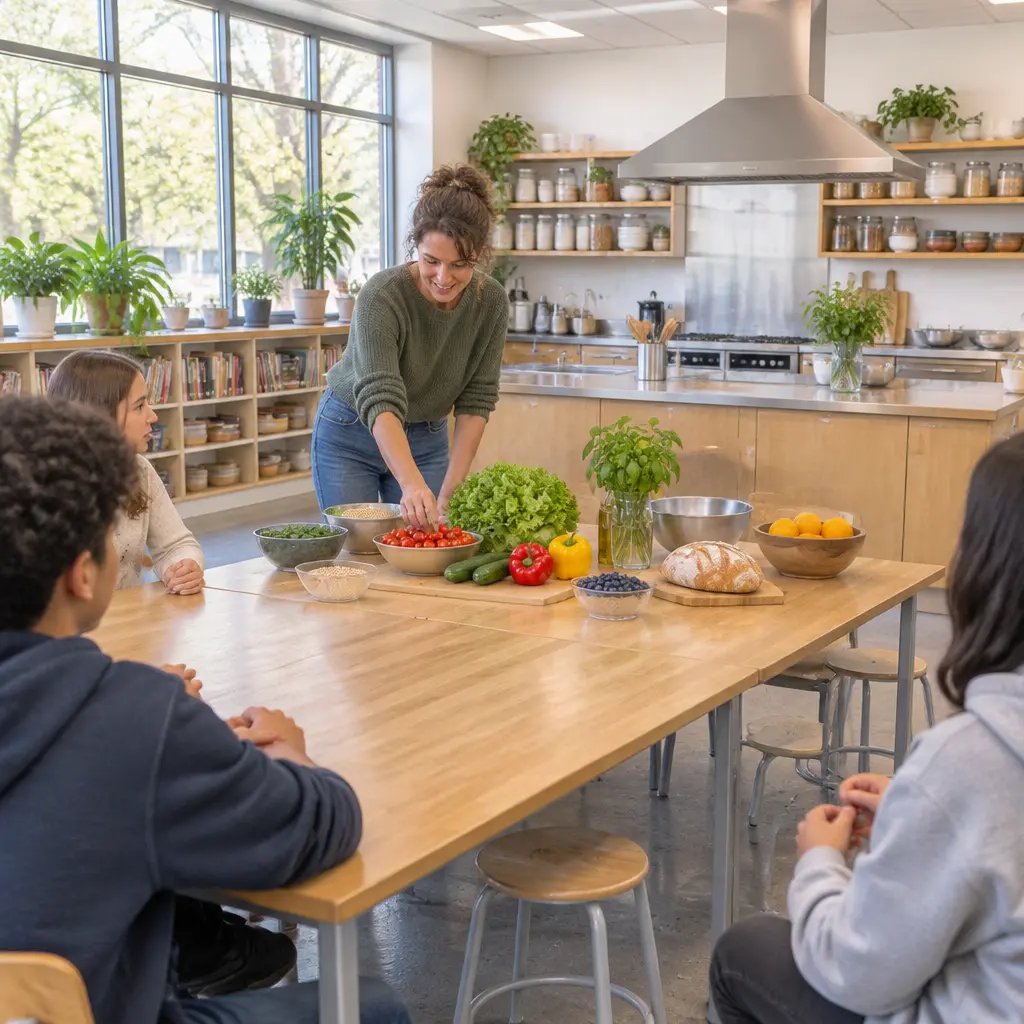
Nutrition education is the age-appropriate teaching of food, eating, and health concepts that helps children build knowledge and practical skills over time. From preschool through high school, it should move from exploring foods and recognizing hunger and fullness to understanding balanced eating patterns, evaluating nutrition information, and making informed choices. The need is substantial: the U.S. Centers for Disease Control and Prevention (CDC) reports that about 1 in 5 U.S. children and adolescents ages 2–19 had obesity in 2017–March 2020. Effective instruction should therefore combine developmentally appropriate lessons with positive food experiences, practical skills, and attention to the school and family environments where choices are made.
Nutrition Education Supports Lifelong Food Literacy
Food literacy is the ability to understand and use information and skills to plan, select, prepare, and eat food in ways that support health and well-being. The U.S. Department of Agriculture (USDA) describes nutrition education in schools as instruction that helps students acquire knowledge and skills to make healthy food and physical-activity choices. This broad definition includes more than memorizing nutrients: students need opportunities to apply learning in everyday settings.
A coherent curriculum builds in stages. Younger children benefit from concrete, sensory activities and simple language; older students can investigate nutrition claims, food systems, and health evidence. The USDA’s Dietary Guidelines for Americans, 2020–2025, recommends establishing healthy dietary patterns across the lifespan, while the CDC’s School Health Guidelines emphasize comprehensive, skills-based health education and supportive school environments. Together, these principles point toward instruction that is practical, inclusive, and reinforced over time.
Core concepts to revisit as students grow
A well-sequenced program returns to a small set of connected ideas at increasing levels of complexity: food variety, fruits and vegetables, whole grains, protein foods, dairy or suitable fortified alternatives, water, food safety, and the role of eating patterns in health. Students should also learn that nutrition needs and food traditions differ, and that a single meal or food does not determine a person’s health.
- Teach patterns rather than labeling individual foods as “good” or “bad.”
- Connect classroom knowledge to meal planning, cooking, shopping, and school meals.
- Discuss hunger, fullness, and body cues without encouraging restrictive eating or shame.
- Use examples that respect cultural foodways, allergies, disabilities, and varied household resources.
Preschool Nutrition Education Builds Familiarity and Self-Regulation
Preschool nutrition education introduces food through safe, positive experiences, helping children notice colors, textures, tastes, and the routines around eating. At this age, teaching is most effective when it is concrete and playful rather than built around abstract nutrient calculations. The USDA’s MyPlate guidance for young children encourages offering a variety of foods and allowing children to respond to hunger and fullness cues within a supportive meal routine.
Food exploration and sensory vocabulary
Food exploration means learning about foods through looking, smelling, touching, and, when a child is ready, tasting. Educators can read picture books about produce, sort toy foods by color, grow herbs, or describe a food’s texture. Repeated, low-pressure exposure can help children become more familiar with unfamiliar foods; adults should avoid forcing a child to taste or finish a portion.
Hunger, fullness, and mealtime routines
Self-regulation is the developing ability to notice internal cues and respond to them. Adults can model simple language such as “My tummy feels full” and provide predictable meals and snacks, while allowing children to decide whether and how much to eat from the foods offered. The National Association for the Education of Young Children recommends responsive feeding practices that respect children’s cues and support a pleasant, unhurried mealtime environment.
Food safety and helping skills
Preschoolers can practice handwashing, sitting while eating, and asking an adult before handling unfamiliar foods. Simple jobs—such as rinsing sturdy produce with supervision or arranging napkins—build participation. Teachers should follow food-allergy plans and safe food-handling procedures, and should never use food as a reward or punishment.
Elementary Nutrition Education Connects Food Groups to Everyday Skills
Elementary nutrition education helps children recognize food groups, understand variety and balance, and apply these concepts to meals and snacks. The USDA’s MyPlate framework depicts fruits, vegetables, grains, protein foods, and dairy as parts of a healthy eating pattern. It is a teaching model, not a rule that every plate must look identical.
Food groups, variety, and balanced meals
Students can learn that foods provide different nutrients and that variety across time matters. Activities might include building a sample meal with foods from several groups, comparing whole-grain and refined-grain examples, or identifying different protein sources. The Dietary Guidelines recommend nutrient-dense choices across food groups while limiting added sugars, saturated fat, and sodium; lessons should explain these ideas without turning them into moral judgments about people or foods.
Practical food skills and school meals
Practical food skills are the actions that make nutrition knowledge usable, including reading a simple recipe, measuring, preparing a no-cook snack, and identifying safe food-handling steps. Schools can connect lessons to cafeteria meals and school gardens. The USDA’s National School Lunch Program served about 4.9 billion lunches in fiscal year 2023, illustrating how school food can provide a daily setting in which students encounter nutrition concepts in practice.
Food access, culture, and respectful discussion
Food access refers to whether individuals and families can obtain enough affordable, nutritious food. Elementary lessons can explore how foods differ across cultures and regions, and how farming, transportation, and family traditions shape meals. Teachers should avoid asking children to disclose household income or food hardship. The USDA reported that 13.5 percent of U.S. households were food insecure at some time during 2023, a reminder that nutrition education must be paired with practical support and not assume every student has the same choices.
Middle School Nutrition Education Develops Decision-Making and Media Literacy
Middle school nutrition education equips students to make choices amid changing bodies, social influences, greater independence, and a rapidly expanding media environment. Instruction should connect nutrition to growth, energy, concentration, and overall well-being while emphasizing that needs vary among individuals. CDC data show that obesity affected about 1 in 5 U.S. children and adolescents ages 2–19 in 2017–March 2020, but lessons should focus on health-supporting behaviors rather than weight stigma.
Nutrition labels and evidence-based choices
Nutrition-label literacy is the ability to interpret information on packaged foods, including serving size, ingredients, and nutrients such as sodium and added sugars. Students can compare two products and discuss how serving size changes the numbers. The U.S. Food and Drug Administration requires the Nutrition Facts label on most packaged foods, making label reading a useful applied skill; however, students should understand that labels do not capture every aspect of a food’s nutritional value or cultural meaning.
Advertising, social media, and misinformation
Media literacy is the ability to evaluate who created a message, what evidence supports it, and whether it is intended to inform or sell. Middle schoolers can examine influencer posts, supplement promotions, and “detox” claims by checking credentials, evidence, and conflicts of interest. The National Institutes of Health’s Office of Dietary Supplements advises consumers to be cautious about supplement claims and to consult qualified health professionals; students should not be encouraged to self-prescribe supplements.
Body respect and balanced eating patterns
Body respect means recognizing that bodies naturally vary in shape, size, development, and ability, and that health cannot be inferred from appearance alone. Lessons should avoid calorie-shaming, public weigh-ins, and “good body/bad body” language. Instead, students can consider how regular meals, hydration, sleep, movement, and supportive relationships contribute to well-being. School staff should refer concerns about disordered eating or nutrition-related health conditions to appropriate professionals.
High School Nutrition Education Builds Independence and Critical Evaluation
High school nutrition education prepares students to manage food choices as they gain independence at home, work, college, or in the community. At this stage, students can evaluate dietary patterns, interpret research, plan meals within a budget, and examine the social and environmental dimensions of food. The CDC’s Youth Risk Behavior Survey reported that 16.9 percent of U.S. high school students had obesity in 2023, reinforcing the importance of supportive prevention efforts that do not stigmatize students or reduce health to body size.
Meal planning, budgeting, and food preparation
Meal planning is the process of choosing meals and snacks that fit a person’s needs, preferences, schedule, and resources. Students can practice comparing unit prices, building a short shopping list, preparing a basic recipe, and adapting meals for allergies or dietary practices. These activities link nutrition science to life skills and help students recognize that nutritious choices can come from many cuisines and price points.
Evaluating diets, supplements, and health claims
Critical evaluation means checking whether a nutrition claim is supported by credible, relevant evidence and whether it oversimplifies a complex topic. Students can compare a social-media claim with guidance from the Dietary Guidelines, the National Institutes of Health, or a registered dietitian. They should learn that supplements are not automatically safe or necessary: the FDA does not approve dietary supplements for safety and effectiveness before they are marketed, so claims and products warrant careful scrutiny.
Food systems, sustainability, and public health
Food systems include the production, processing, distribution, preparation, and disposal of food. High school students can investigate school food procurement, food waste, agricultural practices, and the relationship between food access and community health. The USDA’s Economic Research Service estimated that 13.5 percent of U.S. households experienced food insecurity in 2023; students can use this statistic to discuss how policy, income, geography, and transportation influence food choices without assigning blame to individuals.
Effective Nutrition Teaching Is Inclusive, Practical, and Repeated
Effective nutrition teaching combines accurate information, active practice, and a supportive environment. A single assembly or worksheet is unlikely to build durable skills; students need learning that is revisited across grades and reinforced by school meals, family partnerships, and community resources. The CDC’s Whole School, Whole Community, Whole Child model similarly frames student health as a shared responsibility involving education, services, and the surrounding environment.
Use evidence-based, age-appropriate instruction
Evidence-based instruction draws on credible public-health guidance and teaches students how conclusions are reached. Teachers should distinguish established recommendations from emerging research, avoid overstating single studies, and update materials when guidance changes. The Dietary Guidelines for Americans are revised every five years, providing a national reference for current federal nutrition recommendations.
Make lessons accessible and culturally responsive
Culturally responsive nutrition education recognizes students’ languages, traditions, abilities, and lived circumstances as assets. Use familiar foods alongside new examples, provide accessible cooking and tasting activities, and account for allergies and religious or ethical dietary practices. Do not assume that a family’s food choices reflect a lack of knowledge; availability, cost, time, and access to equipment can all matter.
Connect learning to families and community resources
Family and community connections help students practice skills beyond the classroom. Schools can share low-cost recipes, invite community health professionals, connect families with meal programs, and involve students in gardens or food-preparation projects. Partnerships should protect privacy and present food assistance as a normal community resource rather than a source of shame.
Conclusion: Teach Nutrition as a Growing Set of Lifelong Skills
Nutrition education should progress from preschool food exploration and self-regulation to elementary food-group knowledge, middle-school media literacy, and high-school independence, critical evaluation, and food-systems understanding. Across every grade, the strongest approach is practical, evidence-informed, culturally respectful, and free of weight stigma. Schools and educators can review their curricula, strengthen hands-on learning, and coordinate with families and community services so students gain both the knowledge and the opportunity to apply it.
Sources: Centers for Disease Control and Prevention, Childhood Obesity Facts, https://www.cdc.gov/obesity/data-and-statistics/childhood-obesity-facts.html; U.S. Department of Agriculture and U.S. Department of Health and Human Services, Dietary Guidelines for Americans, 2020–2025, https://www.dietaryguidelines.gov/; U.S. Department of Agriculture, MyPlate for Kids, https://www.myplate.gov/life-stages/kids; Centers for Disease Control and Prevention, School Health Guidelines to Promote Healthy Eating and Physical Activity, https://www.cdc.gov/healthyschools/npao/strategies.htm; National Association for the Education of Young Children, Healthy Eating: Health Tips for Families, https://www.naeyc.org/our-work/families/healthy-eating; U.S. Department of Agriculture, National School Lunch Program, https://www.fns.usda.gov/nslp; U.S. Department of Agriculture, Household Food Security in the United States in 2023, https://www.ers.usda.gov/publications/pub-details/?pubid=109895; U.S. Food and Drug Administration, The Nutrition Facts Label, https://www.fda.gov/food/nutrition-facts-label; National Institutes of Health, Office of Dietary Supplements, Dietary Supplements: What You Need to Know, https://ods.od.nih.gov/factsheets/WYNTK-Consumer/; Centers for Disease Control and Prevention, Youth Risk Behavior Survey Data Summary & Trends Report: 2013–2023, https://www.cdc.gov/yrbs/dstr/index.html; U.S. Food and Drug Administration, Questions and Answers on Dietary Supplements, https://www.fda.gov/food/information-consumers-using-dietary-supplements/questions-and-answers-dietary-supplements; Centers for Disease Control and Prevention, Whole School, Whole Community, Whole Child, https://www.cdc.gov/healthyschools/wscc/index.htm.