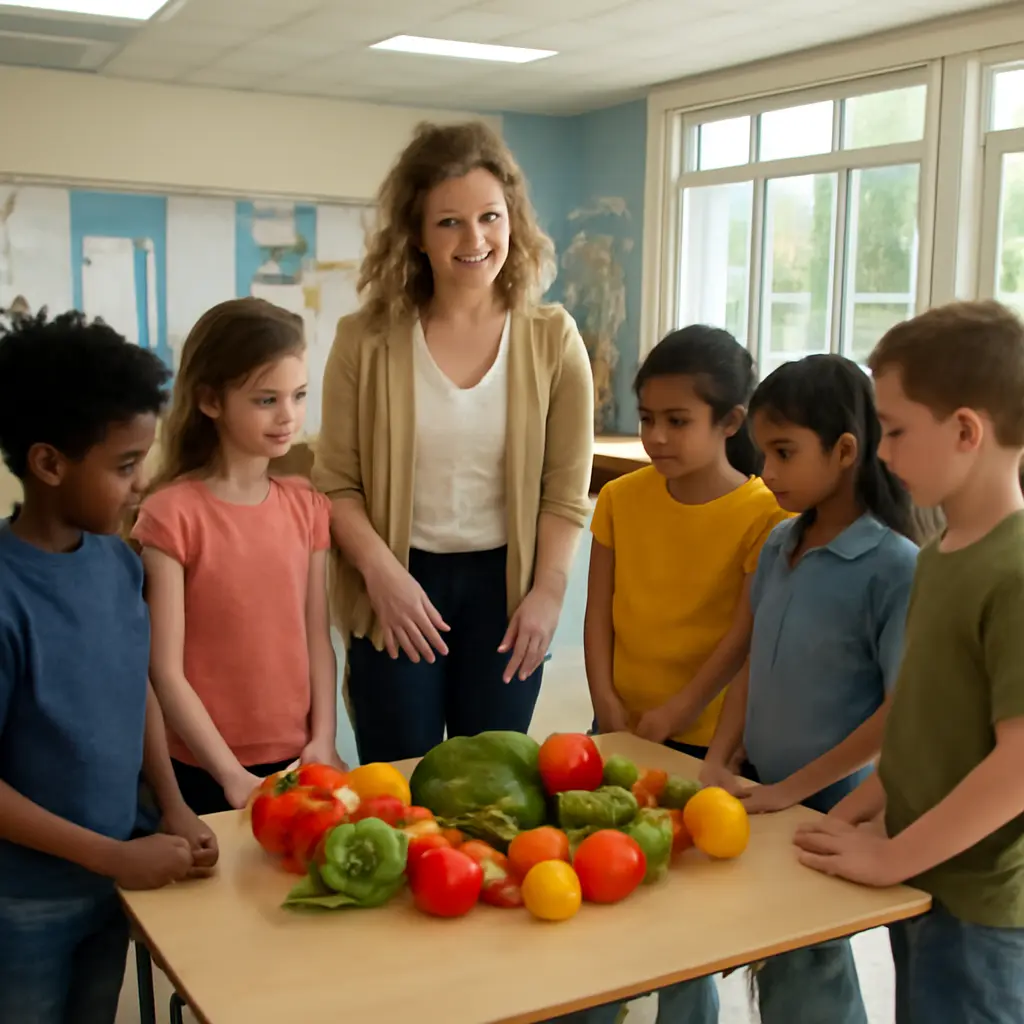
Sensory-first nutrition teaching uses taste, sight, smell, touch, and, where appropriate, sound to help students explore food and connect concrete experiences with nutrition concepts. It can make lessons more engaging and give learners a practical way to discuss variety, food groups, and eating habits—but sensory activities are teaching tools, not a substitute for evidence-based nutrition instruction. This article explains how sensory learning works, outlines classroom approaches and safeguards, and reviews what research and public-health guidance can—and cannot—show about its effects.
Sensory-First Teaching and Nutrition Learning
Sensory-first teaching is an instructional approach that begins with direct observation or experience—such as examining a fruit’s color, smelling herbs, or comparing textures—and then guides students toward language, concepts, and reflection. There is no single universally accepted definition of “sensory-first nutrition teaching.” Here, it refers to structured, age-appropriate food experiences linked explicitly to nutrition learning objectives.
The approach draws on experiential learning: students encounter an example, describe what they notice, connect it to a concept, and reflect on what they learned. In nutrition lessons, the concepts might include food variety, sensory properties, cultural food traditions, or how foods fit into a balanced eating pattern. Tasting is one possible activity, not a requirement; observation, smelling, and discussion can also provide meaningful participation.
The topic matters because diet-related health and food access are significant public-health concerns. The U.S. Centers for Disease Control and Prevention reports that, in 2021–2023, obesity affected 19.7% of children and adolescents ages 2–19 in the United States. That statistic does not show that a particular classroom method prevents obesity. It does, however, underline why schools need accurate, inclusive nutrition education that supports informed choices without stigmatizing students or their bodies.
A practical definition and its limits
A sensory-first lesson uses sensory observation as an entry point, then connects the experience to reliable nutrition information. For example, students might compare the crispness, aroma, and color of different vegetables before discussing variety and the roles of vegetables in dietary patterns. The learning goal is not to declare one food “good” or “bad,” but to help students notice, describe, and understand food.
Sensory exposure should not be confused with a guaranteed health outcome. A classroom tasting may create an opportunity to try an unfamiliar food, but it cannot by itself establish lasting dietary change, improved health, or equal access to nutritious foods. Those outcomes depend on many factors, including family preferences, culture, affordability, availability, and wider school food environments.
Sensory Experiences Build Bridges to Nutrition Concepts
The main educational value of sensory activities is that they give students something specific to observe and describe. The U.S. Department of Agriculture’s MyPlate guidance emphasizes variety across food groups and encourages making half the plate fruits and vegetables. Sensory lessons can give students a concrete starting point for discussing that guidance, while teachers clarify that MyPlate is a broad visual guide rather than an individual prescription.
Related approaches include sensory exploration, guided tasting, food literacy, garden-based learning, and cooking education. They overlap, but they are not identical: sensory exploration focuses on noticing food properties; guided tasting involves sampling when suitable; and food literacy may also address shopping, preparation, culture, and food systems.
Taste and guided tasting
Taste lessons invite students to identify or compare basic taste qualities and to describe flavors in their own words. A teacher might offer small samples of familiar foods and ask learners to notice sweetness, sourness, bitterness, saltiness, or savoriness. The discussion should be descriptive rather than evaluative: “What do you notice?” is more inclusive than “Who likes this?”
A tasting should always be optional and planned around allergies, medical needs, religious practice, and family or cultural preferences. The U.S. Food and Drug Administration identifies nine major food allergens under U.S. law: milk, eggs, fish, crustacean shellfish, tree nuts, peanuts, wheat, soybeans, and sesame. This list is a food-labeling reference, not a complete list of possible allergies or sensitivities; schools should follow their own policies and individual health plans.
Sight, smell, and touch
Visual, olfactory, and tactile activities let students participate without eating. Learners can compare a food’s color or shape, smell an herb, or describe the texture of a whole fruit. These observations can introduce vocabulary and prompt discussion about how foods differ, while avoiding the assumption that appearance alone reveals nutritional value.
This broader participation is important in mixed classrooms, where students may have allergies, sensory sensitivities, religious restrictions, or simply no desire to taste. Offering equivalent roles—such as describing, recording, illustrating, or organizing observations—helps keep the lesson educational without making consumption a condition of participation.
From sensation to nutrition knowledge
Sensory learning becomes nutrition education when teachers connect observations to accurate concepts. A comparison of whole grains, for instance, can lead to a discussion of grain foods and the USDA recommendation to make at least half of grain choices whole grains. Students can examine labels or discuss familiar examples, while recognizing that access, price, and household needs influence food choices.
A useful teaching sequence is to observe, describe, connect, and reflect. Students first notice a food property, then put it into words, connect it to a nutrition or food-literacy concept, and finally reflect on what they learned. This structure prevents a fun activity from becoming disconnected from the lesson’s learning objectives.
Classroom Design Makes Sensory Nutrition Lessons Safer and More Inclusive
An effective sensory lesson combines clear objectives with thoughtful preparation. The Centers for Disease Control and Prevention’s Whole School, Whole Community, Whole Child framework treats health education as one part of a broader school environment. In practice, this means classroom lessons work best when they respect school food policies, student health needs, family context, and the foods students can realistically access.
Plan for safety and student choice
Before handling or serving food, teachers should consult school allergy procedures, verify ingredients and cross-contact risks, use appropriate hygiene practices, and coordinate with relevant school staff. Students should never be pressured to taste, touch, or smell an item. A no-taste option is not a lesser form of participation; it can be a deliberate way to meet the same observation and discussion goals.
- Check school rules and individual health plans before bringing food into the classroom.
- Explain the activity and provide a genuine opt-out or non-tasting role.
- Use clean equipment and follow food-safety procedures for storage, preparation, and serving.
- Avoid ranking students’ bodies, appetites, or family food choices.
Respect culture, sensory needs, and access
Food has cultural, family, and personal meaning. A lesson should not treat one cuisine as the default or imply that students must adopt unfamiliar foods to learn about nutrition. Teachers can invite students to discuss foods they know, use examples from multiple traditions, and avoid asking any student to represent an entire culture.
Access also shapes what students can choose. The USDA’s Economic Research Service reported that 13.5% of U.S. households experienced food insecurity at some point in 2023. This context is a reason to avoid assuming that every household can regularly buy particular foods. Lessons should focus on learning and options, not blame, and should connect students with school or community resources when appropriate.
Evidence Supports Careful Use, Not Overstated Claims
Research on food education includes tasting, gardening, cooking, and multi-component school programs, so results cannot automatically be attributed to sensory activities alone. A 2017 systematic review by Charlotte A. Hersch and colleagues examined school-based interventions intended to increase children’s fruit and vegetable consumption. The authors found that interventions varied in content and outcomes, illustrating why a single tasting lesson should not be presented as proven to produce long-term dietary change.
The strongest practical case is therefore modest: sensory activities can provide engaging opportunities to observe food and practice nutrition vocabulary when they are well designed. To evaluate a program, schools can track learning outcomes—such as students’ ability to identify food groups or describe sensory properties—separately from behavior or health outcomes. Any claim of lasting impact requires appropriate follow-up and evidence beyond immediate classroom participation.
A short lesson example
In a 20-minute lesson, a teacher can present several safe, culturally varied examples from one food category. Students first observe color, shape, smell, or texture without tasting. They then record descriptive words, connect the examples to a nutrition concept such as variety, and discuss how foods can be prepared in different ways. If tasting is offered, it is optional, and students can complete the same learning task through observation.
A simple assessment might ask students to name one sensory feature, explain one nutrition idea, and identify one question they still have. A chart could compare the class’s observations across foods without ranking preferences. Such a chart illustrates learning activity—not proof that students changed their diets.
Conclusion: Sensory-First Nutrition Teaching Connects Experience With Evidence
Sensory-first teaching begins with food experiences and builds toward nutrition understanding through observation, language, and reflection. Taste, sight, smell, and touch can all support participation, while guided tasting remains optional. Strong lessons pair these methods with accurate nutrition guidance, allergy precautions, cultural respect, and awareness of food access.
The broader implication is that nutrition education should help students learn without shame or pressure. Educators can start by choosing one clear learning objective, offering multiple ways to participate, and checking school safety procedures before planning an activity. For further reading, consult USDA MyPlate, CDC school-health resources, FDA allergen guidance, and peer-reviewed reviews of school-based food education.
Sources: Centers for Disease Control and Prevention, Childhood Obesity Facts, https://www.cdc.gov/obesity/data-and-statistics/childhood-obesity-facts.html; U.S. Department of Agriculture, MyPlate, https://www.myplate.gov/; U.S. Food and Drug Administration, Food Allergies, https://www.fda.gov/food/food-labeling-nutrition/food-allergies; Centers for Disease Control and Prevention, Whole School, Whole Community, Whole Child (WSCC), https://www.cdc.gov/whole-school-community-child/about/index.html; U.S. Department of Agriculture, Economic Research Service, Household Food Security in the United States in 2023, https://www.ers.usda.gov/publications/pub-details/?pubid=109895; Hersch, Charlotte A., et al., “Effect of School-Based Health Promotion Interventions on Fruit and Vegetable Consumption in Children: A Systematic Review and Meta-Analysis,” Journal of School Health, 2017, https://doi.org/10.1111/josh.12506.