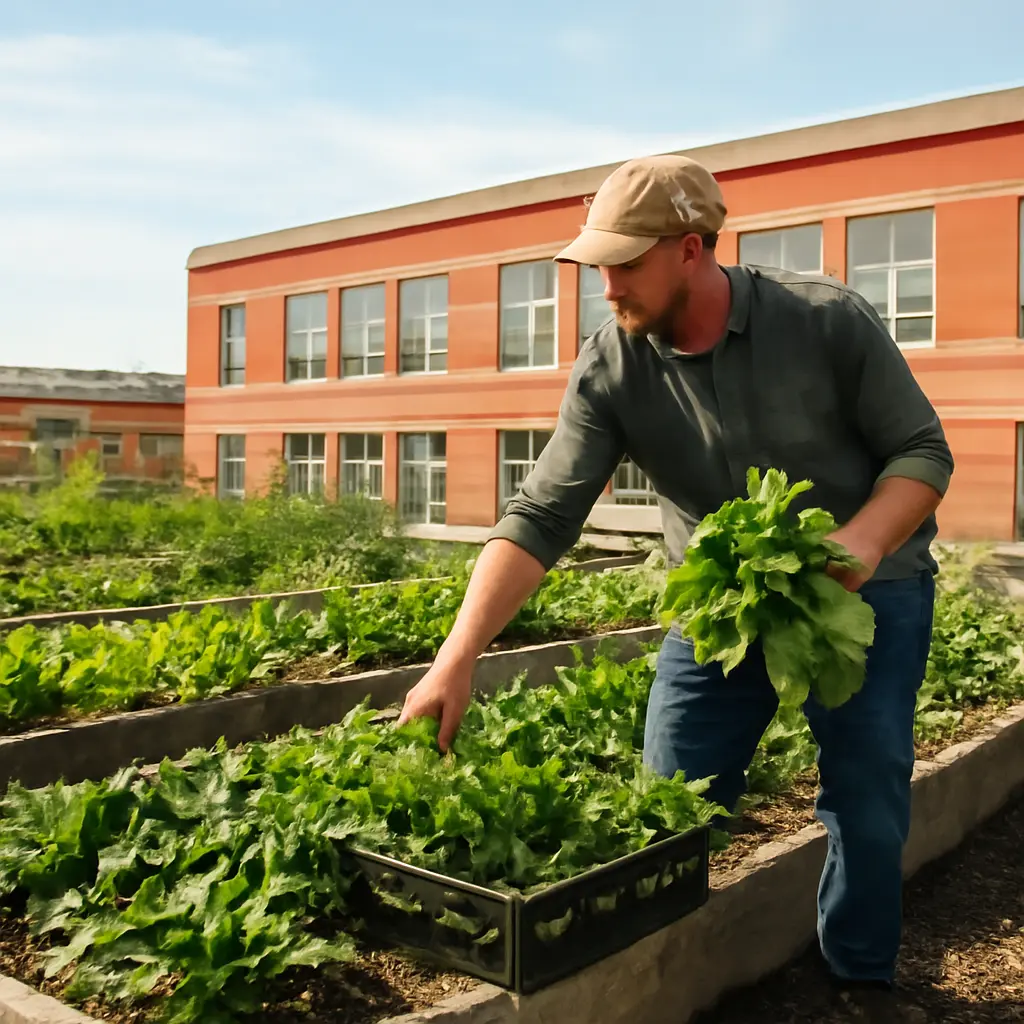
Rooftop farms are growing food above schools and other urban buildings, and some programs use that harvest in student meals, tastings, and lessons. They can bring produce closer to cafeterias while giving students hands-on exposure to food systems—but “feeding students daily” depends on the size of the farm, the school’s purchasing and food-safety arrangements, and what is in season. Research from the U.S. Department of Agriculture and the National Farm to School Network shows why local food and garden-based learning matter, while examples such as Gotham Greens illustrate how commercial rooftop production can supply urban markets. The sections below explain how these farms work, how produce reaches students, and what makes the approach useful and challenging.
Rooftop farming connects urban food production with student meals
A rooftop farm is a food-growing operation established on a building roof, using raised beds, containers, greenhouses, or other growing systems. The University of Maryland Extension describes urban agriculture broadly as producing, processing, and distributing food in or around urban areas; rooftop farms are one form of that activity. When a school or community partner directs the harvest to a cafeteria, the farm becomes part of a farm-to-school program.
The phrase “feeding students fresh produce daily” should be understood as a program goal rather than a universal measure. A small school garden may provide tasting portions or seasonal ingredients, while a larger commercial greenhouse can grow consistent volumes for multiple buyers. Daily service is most plausible when the farm has a dependable harvest, a distribution plan, and cafeteria menus that can adapt to supply.
The stakes extend beyond the amount of food grown. The USDA’s Farm to School Census tracks school food-service purchases from local producers, while the Centers for Disease Control and Prevention recommends that children eat fruits and vegetables as part of a healthy dietary pattern. Rooftop agriculture can support those goals, but it complements rather than replaces broader procurement, nutrition, and food-access programs.
Rooftop farm production determines what students can eat
Rooftop farm production means cultivating crops on a roof and managing the growing environment, harvest, and handling so that food can be used or sold. The Food and Agriculture Organization of the United Nations identifies urban and peri-urban agriculture as a contributor to food availability, livelihoods, and local resilience, while noting that results depend on local conditions and management.
Rooftop farms commonly use several related systems: soil or raised-bed gardens, container growing, hydroponics, and greenhouse production. These are hyponyms—specific forms of rooftop farming—and differ in crop range, infrastructure, water use, and the regularity of harvest. Leafy greens and herbs are especially common in controlled environments because they grow compactly and can be harvested repeatedly.
Raised beds and container gardens
Raised beds and containers hold growing media above the roof surface, allowing schools to cultivate herbs, greens, tomatoes, and other crops without planting directly into the building. They can be accessible for lessons and small harvests, but the roof must be assessed for structural capacity, drainage, wind exposure, and safe access. The University of Maryland Extension advises urban growers to consider soil quality and potential contaminants; rooftop projects also need building-specific engineering and water-management reviews.
These gardens are well suited to educational harvests and seasonal menu additions. Their output can vary with weather, planting schedules, and available labor, so they are more likely to provide a daily learning experience or occasional cafeteria ingredient than a dependable supply of every produce item.
Hydroponic and greenhouse systems
Hydroponics grows plants without conventional field soil, supplying roots with water and dissolved nutrients. A greenhouse can protect crops and extend the growing season, while sensors and controlled systems help manage temperature, light, and irrigation. These systems may support more predictable production than exposed beds, though they require investment, technical skill, energy, and maintenance.
Commercial examples show how controlled-environment agriculture can serve dense cities. Gotham Greens, founded in New York City, operates greenhouse farms and supplies retailers and food-service customers with greens and herbs. Such companies demonstrate the potential for year-round urban production, but a commercial farm’s sales do not automatically mean its produce is included in local school meals; that requires a specific purchasing or partnership arrangement.
Farm-to-school partnerships move rooftop harvests into cafeterias
Farm-to-school is an approach that connects schools with local or regional food producers through food purchasing, education, and school gardens. The National Farm to School Network uses these three connected strands to describe the model. A rooftop farm can contribute to all three: supplying ingredients, supporting classroom lessons, and giving students direct experience with planting and harvest.
The USDA’s 2019 Farm to School Census reported that 65% of responding school food authorities participated in farm-to-school activities during the 2018–19 school year. The census covers many kinds of local food and educational programs, not rooftop farms alone. It nevertheless shows that school food systems already have established ways to connect producers and students.
Cafeteria purchasing and menu planning
Cafeteria integration is the process of fitting farm harvests into meal-service requirements, menus, budgets, and food-safety procedures. Schools may use greens in salads, herbs in sauces, or seasonal vegetables in prepared dishes. To make service dependable, farm managers and food-service staff need to coordinate harvest quantities, delivery days, packaging, washing, storage, and substitutions.
A school kitchen cannot necessarily use every crop in the same way or on the same schedule. Procurement rules, staffing, equipment, and meal-pattern requirements shape what can be served. A practical plan therefore distinguishes between crops grown for cafeteria use, crops intended for tastings or classroom activities, and surplus that may be donated or sold through another channel.
Nutrition education and student participation
Garden-based nutrition education uses growing, preparing, and tasting food to help students understand where meals come from. The CDC’s school nutrition guidance supports making fruits and vegetables accessible and promoting healthy eating environments. A rooftop garden can make those ideas concrete, allowing students to observe a crop’s growth and taste produce at its freshest.
Participation can include seed starting, crop monitoring, harvest, cooking demonstrations, or cafeteria tastings. These activities are educational benefits, not evidence by themselves that students consume more produce. Programs can assess participation and outcomes through harvest records, meal counts, student surveys, and food-waste measurements.
Rooftop farms offer benefits but require careful planning
Rooftop farms can shorten the distance between production and consumption, create learning opportunities, and make productive use of otherwise underused urban space. They may also provide some insulation and manage rainfall, depending on the roof design. These benefits vary by project and should be weighed against construction, energy, labor, and maintenance requirements.
A rooftop farm is not automatically more sustainable than every ground-level farm. Life-cycle impacts depend on building materials, greenhouse heating and lighting, water and nutrient management, crop yields, transport, and the energy source. The National Research Council’s work on urban agriculture emphasizes that urban production can contribute to food systems while facing constraints such as land access, contamination, and regulation.
Structural safety, water, and food handling
Structural safety means confirming that a roof can bear the combined weight of growing media, crops, people, equipment, and retained water. Building owners should obtain professional engineering review before installation. Roof access, fall protection, drainage, wind loading, irrigation supply, and emergency procedures also need explicit plans.
Food safety includes clean water, hygienic harvest practices, suitable storage, and traceability. The U.S. Food and Drug Administration’s Produce Safety Rule establishes standards for covered farms, although applicability depends on farm size, sales, and exemptions. Schools and growers should determine which requirements apply and agree on handling procedures before produce enters a cafeteria.
Seasonality, cost, and equitable access
Seasonality is the pattern of crop availability across the year. Outdoor rooftop beds in colder climates may have limited winter output, while heated greenhouses can extend production at additional energy and operating cost. Schools can manage this variation through seasonal menus, preserved harvests where appropriate, and complementary purchasing from regional farms.
Equitable access means ensuring that the benefits reach students regardless of household income, school resources, or neighborhood investment. Grants, public procurement support, community partnerships, and paid farm staff can help prevent rooftop projects from depending solely on volunteer labor. Program evaluations should track who participates and who receives the food, not just how much is harvested.
Conclusion: Rooftop farms can strengthen student food systems
Rooftop farm production can bring fresh ingredients and food education closer to students, while farm-to-school partnerships provide a route from harvest to cafeteria. Raised beds, hydroponics, and greenhouse systems each offer different levels of scale and consistency. The most effective projects match crop choices to kitchen needs and account for structural safety, food handling, seasonality, cost, and equitable access.
Schools considering a rooftop farm should begin with a feasibility assessment, involve facilities and food-service teams early, and define measurable goals for harvest, student participation, and cafeteria use. For further reading, consult the USDA Farm to School Census, National Farm to School Network resources, and FDA produce-safety guidance. With careful planning, a rooftop can become both a productive growing space and a practical classroom—while remaining one part of a broader strategy for nutritious school meals.
Sources: U.S. Department of Agriculture, Farm to School Census, 2019, https://www.fns.usda.gov/cfs/farm-school-census; National Farm to School Network, What is Farm to School?, https://www.farmtoschool.org/about/what-is-farm-to-school; Centers for Disease Control and Prevention, School Nutrition, https://www.cdc.gov/school-health/what-works/school-nutrition.html; University of Maryland Extension, Urban Agriculture, https://extension.umd.edu/resource/urban-agriculture/; Food and Agriculture Organization of the United Nations, Urban and peri-urban agriculture, https://www.fao.org/urban-peri-urban-agriculture/en/; Gotham Greens, Our Farms, https://www.gothamgreens.com/our-farms/; U.S. Food and Drug Administration, FSMA Final Rule on Produce Safety, https://www.fda.gov/food/food-safety-modernization-act-fsma/fsma-final-rule-produce-safety; National Research Council, Urban Agriculture: Emerging Opportunities and Challenges, 2015, https://nap.nationalacademies.org/catalog/19015/urban-agriculture-emerging-opportunities-and-challenges.