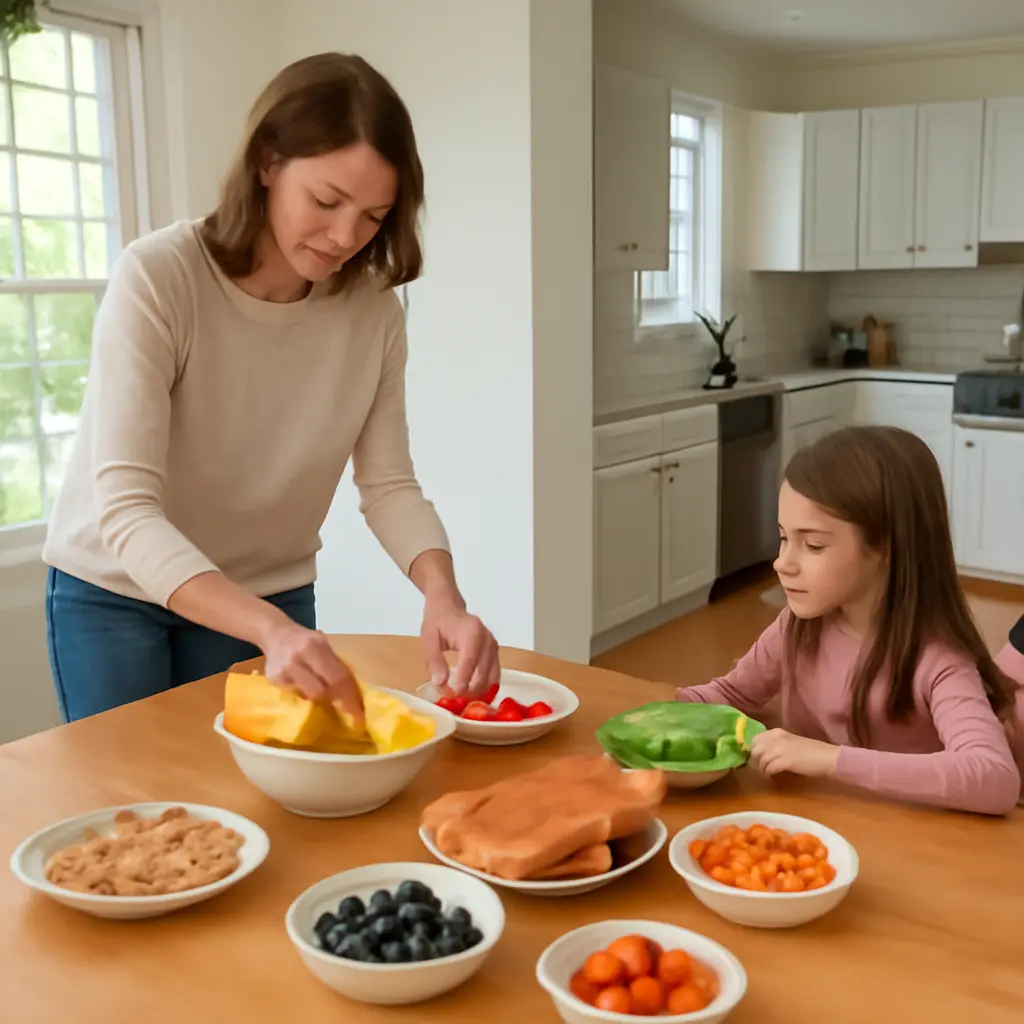
Balanced eating for children means offering a variety of nourishing foods while allowing children to decide whether and how much to eat. It is not a requirement to finish every bite or to like every food. This approach can support nutrition and a calmer relationship with food: the American Academy of Pediatrics (AAP) recommends repeated, pressure-free exposure to new foods, while the Centers for Disease Control and Prevention (CDC) notes that young children may need to see a food many times before accepting it. Because food preferences develop over time, caregivers can encourage variety without turning meals into contests, rewards, or negotiations.
Balanced Eating Supports Children’s Food Acceptance
Balanced eating is a flexible pattern of eating that includes different food groups and supports a child’s growth, development, and health over time. The USDA’s MyPlate guidance organizes foods into fruits, vegetables, grains, protein foods, and dairy or fortified alternatives; it is a practical guide, not a scorecard for any single meal. The AAP’s responsive-feeding guidance adds an important behavioral principle: adults provide appropriate food and structure, while children respond to their own hunger and fullness cues.
This distinction matters because selectivity is common in childhood. The AAP describes picky eating as a frequent developmental phase, particularly among toddlers and preschoolers, when children may be cautious about unfamiliar tastes and textures. A child’s refusal at one meal does not by itself show that the overall diet is inadequate. Patterns across days and weeks—and a child’s growth and wellbeing—are more useful than judging one plate.
Variety is a pattern, not a single-meal target
Dietary variety means offering foods with different flavors, colors, textures, and nutrient profiles over time. For example, a child who declines cooked carrots might eat raw carrot sticks another day, or enjoy a different vegetable altogether. The Dietary Guidelines for Americans encourage nutrient-dense choices across food groups, but caregivers do not need to make every meal perfectly balanced. A familiar food alongside a less familiar one can make exploration feel manageable.
Picky eating and food neophobia are related but not identical
Picky eating generally refers to a limited range of accepted foods or reluctance to try foods. Food neophobia specifically means hesitation toward unfamiliar foods. These behaviors can overlap, and they often arise as children become more independent. The AAP advises patience and repeated, low-pressure exposure; acceptance may take multiple encounters. There is no need to insist that a child taste a food every time it is served.
Responsive Feeding Builds Balanced Eating Without Pressure
Responsive feeding is an approach in which caregivers notice and respond appropriately to a child’s hunger, fullness, and developmental signals. The National Institute of Child Health and Human Development describes feeding as an interaction: the adult offers food and structure, and the child signals whether and how much to eat. This division of responsibility helps adults guide the food environment without trying to control a child’s appetite.
Caregivers choose what, when, and where
Caregivers are responsible for offering safe, age-appropriate foods and establishing predictable meals and snacks in a suitable setting. A regular routine can help children arrive at meals ready to eat, while reducing grazing that may interfere with appetite. Within that structure, serve at least one familiar food when possible, and keep the meal calm. Adults can model eating a range of foods without making the child’s participation a condition of praise or attention.
Children decide whether and how much to eat
A child’s role is to listen to internal hunger and fullness cues and decide whether to eat from what is offered. The USDA’s child-feeding materials and pediatric guidance caution against pressuring children to clean their plates. Appetite naturally varies with activity, growth, sleep, and illness. If a child says they are full, caregivers can respond neutrally rather than bargaining for “just one more bite.”
Repeated exposure works best when it is low-pressure
Exposure includes seeing, smelling, touching, helping prepare, or tasting a food. The CDC advises offering a new food alongside familiar foods and notes that children may need to encounter a food many times before accepting it. A practical example is placing a small portion of roasted broccoli on the table without requiring a taste, then serving it again on another occasion in a different form. Neutral repetition makes familiarity possible without turning refusal into a conflict.
Mealtime Practices Encourage Variety and Trust
The principles of responsive feeding become concrete through everyday routines. A predictable, pleasant meal environment can support both food exploration and a child’s trust in their own appetite. The goal is not to persuade a child to eat a particular item at any cost; it is to make nutritious options available and keep the door open for future acceptance.
Serve familiar foods alongside new foods
A familiar food is one the child usually accepts; a new or less-preferred food is one they are still learning about. Serving both reduces the chance that a child faces an unfamiliar plate with no comfortable option. For example, offer a known grain and a preferred protein alongside a small serving of a new vegetable. Keep portions age-appropriate and allow the child to ask for more if still hungry.
Invite children into food preparation
Age-appropriate participation—washing produce, stirring batter, choosing between two vegetables, or arranging food on a plate—creates non-eating exposure and can make foods more familiar. It does not guarantee that a child will taste or like the result, and that is fine. The CDC’s guidance on encouraging healthy eating emphasizes offering choices and involving children in food-related activities as practical ways to support interest.
Avoid pressure, food rewards, and negative labels
Pressure includes insisting on bites, withholding dessert until a child eats vegetables, or praising a child for eating beyond fullness. These strategies can make food a source of conflict and may distract children from their own appetite cues. Avoid calling a child “picky” in front of them or treating a disliked food as bad. Instead, describe foods neutrally—“crunchy,” “sweet,” or “soft”—and let children explore without a required outcome.
Nutrition Needs and Selective Eating Require Individual Attention
A varied diet is a useful long-term goal, but children differ in appetite, sensory preferences, culture, development, and health needs. Balanced eating should therefore be considered alongside growth, access to food, and the child’s overall functioning. Some selectivity is ordinary; persistent or severe restriction can require individualized support rather than more pressure at the table.
Use nutrition guidance as a flexible framework
MyPlate’s food groups offer a broad way to think about variety, while the Dietary Guidelines for Americans provide age-specific nutrition recommendations. Families can adapt these ideas to cultural foods, allergies, medical advice, budget, and availability. A single skipped vegetable does not define a child’s diet, and caregivers should avoid using a rigid checklist to judge meals. When a child has a restricted diet, a pediatrician or registered dietitian can assess whether substitutions or supplements are needed.
Know when to seek professional guidance
Discuss feeding concerns with a pediatrician if a child’s accepted-food range is shrinking, meals cause significant distress, growth is faltering, or eating difficulties interfere with daily life. Seek prompt advice for concerns such as choking, pain, frequent vomiting, difficulty swallowing, or suspected nutrient deficiency. Sensory, developmental, gastrointestinal, or other medical factors may affect eating; a clinician can determine whether referral to a dietitian, feeding therapist, or other specialist is appropriate.
Conclusion: Make Balanced Eating a Calm, Ongoing Practice
Balanced eating supports children through variety over time, while responsive feeding protects their ability to notice hunger and fullness. Caregivers can create routine, offer familiar and unfamiliar foods together, involve children in preparation, and repeat exposure without pressure. Because food acceptance develops gradually and selectivity is common, patience is more useful than forcing bites or demanding a clean plate. Start with one manageable change—such as adding a familiar food beside a new one—and consult a pediatric professional when feeding concerns affect growth, health, or family life.
Sources: American Academy of Pediatrics, “Picky Eaters” (HealthyChildren.org), https://www.healthychildren.org/English/ages-stages/toddler/nutrition/Pages/Picky-Eaters.aspx; Centers for Disease Control and Prevention, “Tips to Help Your Child Eat Better,” https://www.cdc.gov/infant-toddler-nutrition/foods-and-drinks/tips-to-help-your-child-eat-better.html; U.S. Department of Agriculture, MyPlate, https://www.myplate.gov/; U.S. Department of Agriculture and U.S. Department of Health and Human Services, Dietary Guidelines for Americans, 2020–2025, https://www.dietaryguidelines.gov/; National Institute of Child Health and Human Development, “Responsive Feeding,” https://www.nichd.nih.gov/health/topics/factsheets/responsive-feeding