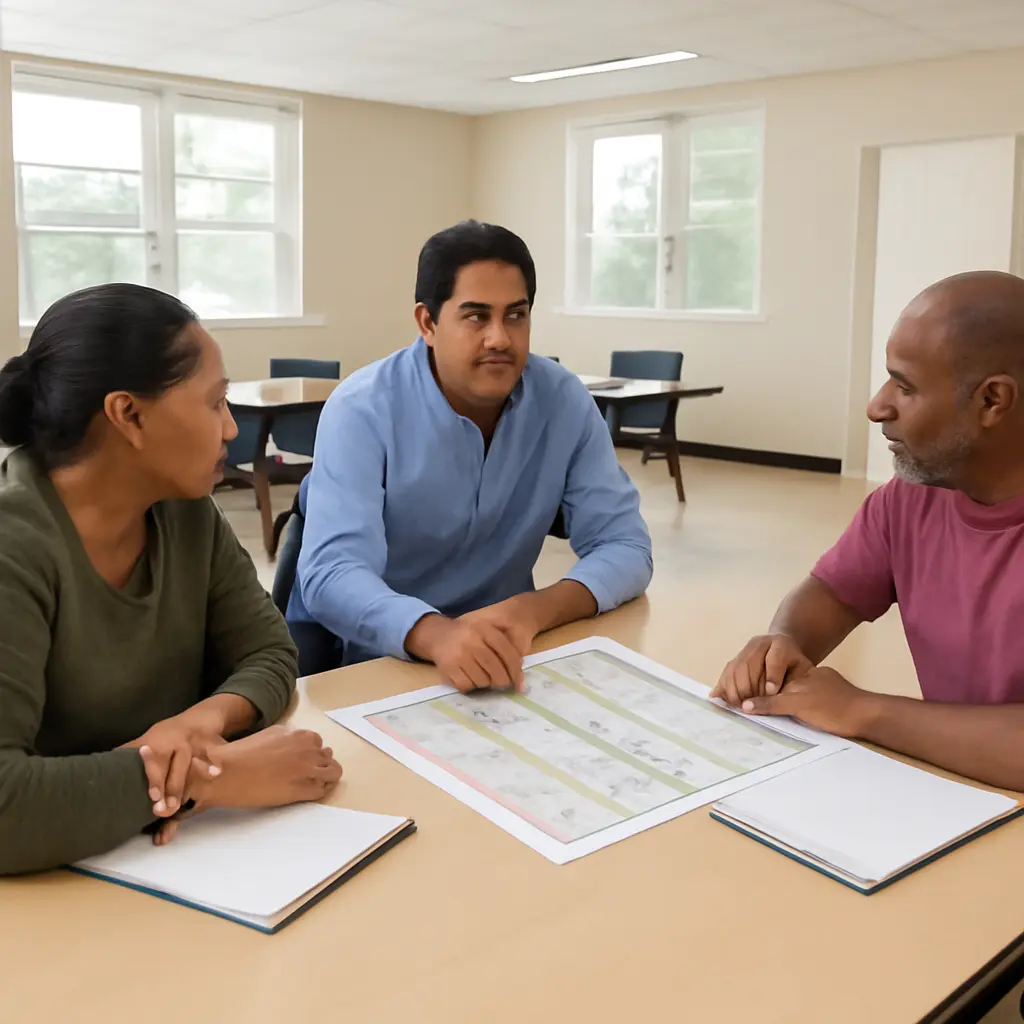
Community partnership in wellness means residents, local organizations, health professionals, and public agencies share decisions and responsibility for improving health and well-being. When communities help define priorities and shape services—not merely receive them—wellness efforts can better reflect local needs, build trust, and address conditions such as housing, food access, safety, and social connection. The approach matters at scale: the U.S. Centers for Disease Control and Prevention reports that social and economic conditions influence health outcomes, while the National Academies has emphasized meaningful community engagement as a way to make health programs more responsive and equitable. This article explains what partnership entails, how it supports better outcomes, which models communities use, and how to evaluate progress.
Shared Decision-Making Defines Community Wellness Partnership
A community wellness partnership is a structured, continuing collaboration in which community members and institutions jointly identify health priorities, design responses, and assess results. The National Academies of Sciences, Engineering, and Medicine describes community engagement as a process of working collaboratively with groups connected by geography, shared interests, or circumstances to address issues affecting their well-being. In practice, partnership ranges from consultation to shared governance; its defining feature is that residents have meaningful influence over decisions and resources.
This distinction matters. A one-time survey can collect opinions, but it does not necessarily transfer decision-making power. A genuine partnership establishes ways for community knowledge to shape goals, budgets, delivery, and evaluation. The CDC’s social determinants of health framework reinforces why this matters: health is influenced by the conditions in which people are born, grow, live, work, and age, not only by clinical care.
Co-design and shared governance
Co-design is the joint development of services or programs by the people who will use them and the organizations that provide them. Shared governance goes further by giving community representatives formal authority—for example, seats on steering committees, a vote on priorities, or control over part of a program budget. These approaches can expose practical barriers that outside planners miss, such as unsuitable clinic hours, transportation gaps, language needs, or distrust rooted in past experiences.
The World Health Organization’s community-engagement guidance emphasizes participation, transparency, and accountability as foundations for effective collaboration. To make those principles concrete, partners can publish how decisions are made, compensate residents for their expertise, and report back on which suggestions were adopted and why.
Community-based participatory research
Community-based participatory research, or CBPR, is a research approach in which community members and researchers share expertise and responsibility across the research process. Partners may jointly choose research questions, recruit participants, interpret results, and decide how findings are used. The approach recognizes that residents hold valuable knowledge about local context, while researchers contribute methods for collecting and analyzing evidence.
The National Institutes of Health has supported community-engaged research as a way to improve the relevance and use of health research. CBPR is especially useful when communities have experienced exclusion from research or when conventional studies have not addressed local priorities. It also requires time: trust-building, fair compensation, data stewardship, and shared interpretation should be planned rather than treated as incidental tasks.
Community Partnership Improves the Relevance of Wellness Programs
A partnership can improve wellness outcomes by aligning interventions with local circumstances, strengthening relationships, and connecting clinical services with community resources. It does not guarantee better health by itself; outcomes depend on sustained participation, adequate funding, effective implementation, and attention to structural barriers. Still, community knowledge can help partners choose interventions that are more accessible and acceptable to the people they aim to serve.
Trust, access, and cultural relevance
Trust is the expectation that partners will listen, act fairly, protect people’s interests, and follow through. Community organizations and trusted local leaders can help institutions communicate in familiar languages, adapt services to cultural preferences, and reach people who may be missed by conventional outreach. Partnership also makes it easier to identify barriers such as cost, disability access, limited internet, work schedules, or concerns about confidentiality.
The CDC’s principles for community engagement advise organizations to learn about a community’s history, norms, and existing leadership before initiating work. That groundwork is important because engagement that is rushed or extractive can deepen skepticism rather than build confidence. Practical signs of trustworthiness include consistent communication, clear privacy practices, accessible meeting formats, and visible action on community feedback.
Addressing social determinants of health
Social determinants of health are the nonmedical conditions that shape health risks and opportunities, including housing, education, income, employment, transportation, food access, and social connection. Wellness partnerships can connect health systems with schools, housing providers, food organizations, libraries, faith groups, and local government to address needs that a clinic cannot resolve alone.
The U.S. Department of Health and Human Services’ Healthy People 2030 initiative organizes these influences into five domains: economic stability; education access and quality; health care access and quality; neighborhood and built environment; and social and community context. This framework helps partners avoid defining wellness too narrowly. For example, a diabetes program may combine clinical coaching with access to affordable healthy food, safe places to walk, and transportation to appointments.
Prevention and resilience
Prevention-focused partnerships work before problems become crises, while resilience efforts help communities prepare for, respond to, and recover from disruptions. Local networks can support vaccination outreach, mental-health education, heat-safety checks, emergency communication, and social connection for people at risk of isolation. Their strength lies partly in established relationships and knowledge of local resources.
The COVID-19 pandemic illustrated both the value and the difficulty of these networks. Community-based organizations often helped share public-health information and connect residents with services, while uneven access to resources and differences in trust complicated response efforts. The lesson is to build and fund relationships before an emergency, rather than expecting informal community networks to replace adequately resourced public services.
Community Partnership Requires Equitable Practices and Clear Measurement
A partnership is more likely to endure when it shares power fairly, makes participation feasible, and measures both results and the quality of collaboration. Without these foundations, engagement can become symbolic: residents may be asked for input without receiving influence, compensation, or feedback. Equity therefore concerns not only who benefits from a program but also who sets its priorities and controls its resources.
Representation, compensation, and accountability
Representative engagement includes people most affected by an issue, including groups often underrepresented in institutional decision-making. Partners should consider language, disability access, childcare, transportation, meeting times, digital access, and compensation for participants’ time and expertise. These supports reduce the risk that participation is limited to people with the greatest flexibility or institutional familiarity.
Accountability means explaining what happened after community members contributed. A simple “you said, we did, we could not do” report can document which recommendations were adopted, what resources were committed, and what constraints remain. Written agreements can also clarify data ownership, confidentiality, authorship, decision rights, and how partners will resolve disagreements.
Measuring outcomes and partnership quality
Evaluation should track health outcomes alongside the partnership processes that may produce them. Depending on the initiative, measures could include participation, service access, screening or vaccination rates, food security, physical activity, mental well-being, avoidable hospital use, or participants’ reported sense of belonging. Partners should select indicators together and examine results by relevant groups so that averages do not hide unequal effects.
The CDC’s framework for program evaluation recommends involving stakeholders throughout evaluation and using findings to improve programs. Community partners can help determine whether an indicator is meaningful, whether data collection is respectful, and how results should be interpreted. A useful evaluation plan combines quantitative measures with interviews, listening sessions, or other qualitative methods that explain why outcomes changed—or did not.
Sustained funding and institutional change
Sustained partnership requires more than short-term project grants. Organizations need funding for coordination, resident compensation, interpretation, data capacity, and ongoing relationship-building. They may also need to change internal policies so community input can affect procurement, staffing, service design, and budget decisions.
The National Academies has noted that effective community engagement depends on authentic relationships and shared goals, rather than treating participation as a one-off activity. Long-term funding helps partnerships retain experienced community leaders and evaluate effects over time. It also allows a program to adapt when community priorities, evidence, or local conditions change.
Real-World Models Show How Partnerships Can Work
Community wellness partnerships take different forms, but they share a practical sequence: identify priorities with residents, combine relevant expertise and resources, deliver services in accessible ways, and review results together. Examples from public health and clinical care show how this sequence can connect institutions to local knowledge.
Community health workers and local navigation
Community health workers are trusted public-health or health-care team members who use their understanding of local communities to provide education, outreach, navigation, and social support. The Community Preventive Services Task Force recommends interventions engaging community health workers for several health outcomes, including cardiovascular disease prevention and management. Their work may include helping residents understand care plans, find community resources, and overcome practical barriers to appointments.
The model illustrates why partnership must include fair employment and supervision. Community health workers should be compensated, trained, and integrated into care teams without losing the community relationships that make their role valuable. Programs should also measure whether navigation improves access and continuity, rather than counting contacts alone.
Accountable health communities
The Centers for Medicare & Medicaid Services’ Accountable Health Communities Model tested whether systematic screening for health-related social needs, referral to community services, and stronger clinical-community partnerships could reduce unmet needs and avoidable health-care use. The model reflects a broader shift: health systems can identify social needs, but community organizations often provide the housing, food, transportation, or other support required to address them.
Such models work best when referrals lead to services with real capacity. Screening without available community resources can create frustration for patients and organizations alike. The partnership task is therefore both to coordinate individual referrals and to identify recurring gaps that may require collective advocacy, investment, or policy change.
Conclusion: Wellness Outcomes Improve When Communities Share Power
Community partnership on wellness outcomes is a practical way to connect shared decision-making with more relevant services, action on social determinants, and prevention. Co-design and community-based participatory research bring local expertise into planning; equitable practices make participation meaningful; and joint evaluation helps partners learn whether programs are working for the people most affected. Examples such as community health worker programs and accountable health community models demonstrate how collaboration can link health care with community resources.
Organizations can begin by asking residents what matters most, compensating them for their contributions, agreeing on decision rights, and choosing a small set of outcomes to review together. The broader implication is that wellness is not produced by institutions acting alone: it depends on conditions and relationships across the community. Further reading from the CDC, National Academies, and Healthy People 2030 can help partners build an evidence-informed approach suited to local priorities.
Sources: National Academies of Sciences, Engineering, and Medicine, Communities in Action: Pathways to Health Equity, 2017, https://nap.nationalacademies.org/catalog/24624/communities-in-action-pathways-to-health-equity; Centers for Disease Control and Prevention, Social Determinants of Health, https://www.cdc.gov/about/priorities/why-is-addressing-sdoh-important.html; World Health Organization, Community Engagement: A Health Promotion Guide for Universal Health Coverage in the Hands of the People, 2020, https://www.who.int/publications/i/item/9789240010529; National Institutes of Health, Community-Based Participatory Research, https://www.nimhd.nih.gov/programs/extramural/community-based-participatory.html; U.S. Department of Health and Human Services, Healthy People 2030, Social Determinants of Health, https://health.gov/healthypeople/priority-areas/social-determinants-health; Centers for Disease Control and Prevention, Principles of Community Engagement, 2nd Edition, 2011, https://www.atsdr.cdc.gov/communityengagement/pdf/PCE_Report_508_FINAL.pdf; Centers for Disease Control and Prevention, CDC Program Evaluation Framework, https://www.cdc.gov/evaluation/php/about/index.html; Community Preventive Services Task Force, Cardiovascular Disease Prevention and Control: Interventions Engaging Community Health Workers, https://www.thecommunityguide.org/findings/cardiovascular-disease-prevention-and-control-interventions-engaging-community-health-workers.html; Centers for Medicare & Medicaid Services, Accountable Health Communities Model, https://innovation.cms.gov/innovation-models/ahcm.