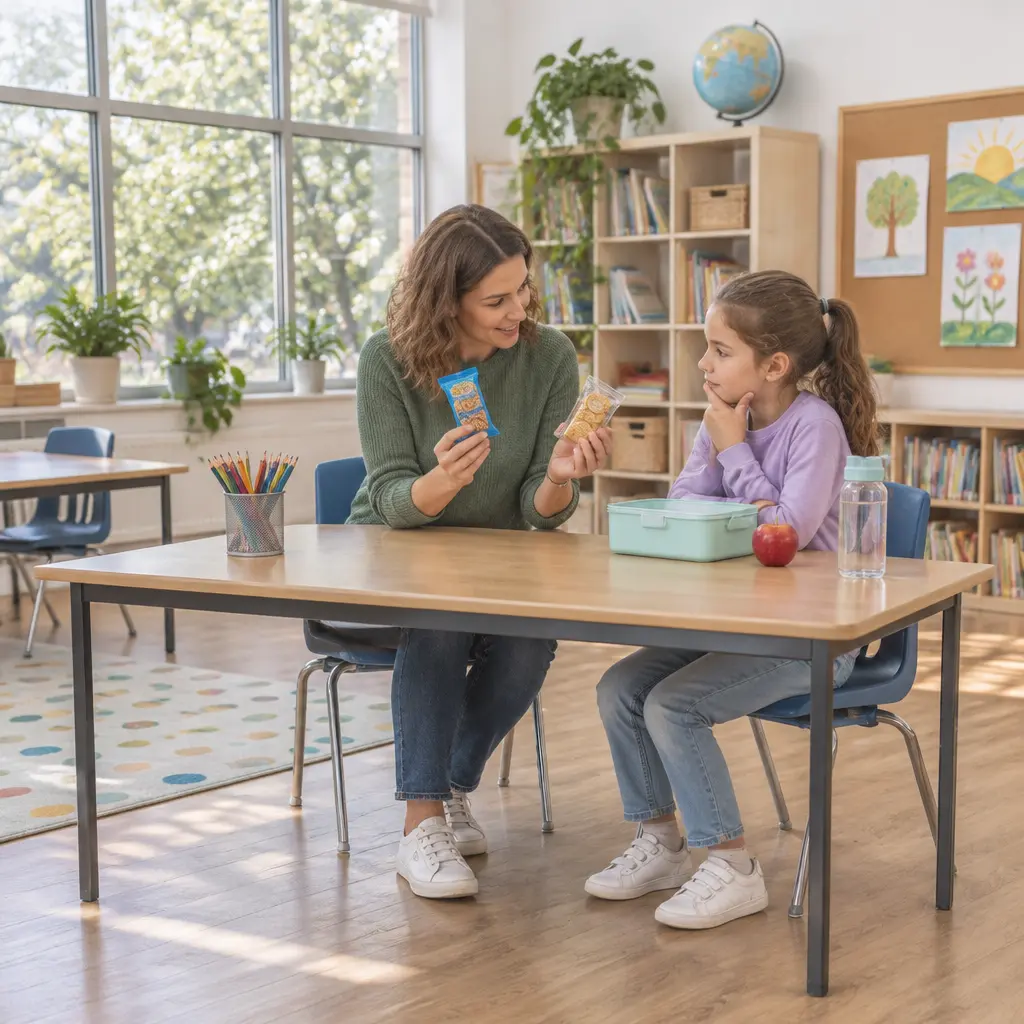
Food-label literacy is the ability to find and interpret nutrition and ingredient information to make informed food choices. Lunchbox activities can make this skill practical: children compare familiar packages, practice serving-size math, and discuss ingredients without labeling foods or people as “good” or “bad.” The need is substantial: the U.S. Food and Drug Administration (FDA) reports that the Nutrition Facts label is intended to help people make informed choices, while the Centers for Disease Control and Prevention (CDC) reports that most U.S. children eat more sodium than recommended. This guide explains what label analysis involves, how to teach it through age-appropriate lunchbox activities, and how to keep the lessons accurate, inclusive, and useful.
Food-label literacy and lunchbox analysis
Food-label literacy combines the ability to locate information on a package with the ability to interpret it in context. The FDA describes the Nutrition Facts label as a tool for understanding nutrients and serving information; in classroom or family activities, that tool becomes a prompt for comparing foods children already encounter. Lunchbox analysis is one practical form of nutrition education: children inspect packages, ask questions, and explain their reasoning rather than simply memorizing rules.
The topic matters because food choices are made amid abundant packaged options, and label details can be easy to misread. The CDC says that children and adolescents ages 2–18 consume an average of about 3,300 milligrams of sodium per day, above the recommended limit of less than 2,300 milligrams for ages 14 and older; recommended limits are lower for younger children. These population figures do not determine what any individual child should eat, but they show why learning to notice sodium and serving sizes can be valuable.
What children learn to notice
A useful label-reading routine asks children to locate the serving size, servings per package, calories, selected nutrients, and ingredient list. The FDA emphasizes that serving sizes reflect amounts people typically consume, not a recommendation of how much to eat. Therefore, children should compare the serving listed with the amount they actually pack or eat, while avoiding the assumption that a package always contains one serving.
Why hands-on comparison helps
Comparing real packages turns abstract numbers into a concrete task. A child can line up two crackers, yogurts, or snack bars and ask which has more fiber per labeled serving, whether the serving sizes match, and what ingredients appear near the beginning of each list. The lesson is not that one product is automatically superior: taste, allergies, culture, access, cost, and the rest of the meal all matter.
Nutrition Facts label features for lunchbox learning
The Nutrition Facts label is the standardized panel on most packaged foods and beverages in the United States. The FDA defines its purpose as helping consumers make informed food choices by presenting serving size, calories, and nutrient information in a consistent format. For children, the most teachable features are serving size, percent Daily Value, nutrients to notice, and the ingredient list; together, they help distinguish a quick number check from a fuller comparison.
Serving size and servings per package
Serving size is the reference amount used to calculate the figures on the label. If a pouch contains two servings and a child eats the whole pouch, the nutrients consumed may be roughly twice the listed amounts. Children can practice multiplying simple figures, but the teaching point is awareness—not calorie counting or pressure to restrict food. Use a calculator or visual counters if arithmetic is a barrier.
Percent Daily Value
Percent Daily Value (%DV) shows how much a nutrient in one serving contributes to a general daily reference amount. The FDA’s label guide uses 5% DV or less as a general guide for a low amount and 20% DV or more as a general guide for a high amount. These are comparison aids, not personalized targets. Children can identify a nutrient with a higher or lower %DV, then discuss why the whole day’s diet and individual needs matter.
Nutrients to compare
For a lunchbox activity, choose a small number of nutrients rather than asking children to judge every line. Fiber, sodium, added sugars, and selected vitamins or minerals can support useful comparisons. The FDA’s updated label design includes “Added Sugars,” making it easier to distinguish added sugars from total sugars. A comparison should use the same basis—such as per serving or per 100 grams—and account for serving-size differences.
Ingredient lists and allergen information
Ingredients are generally listed in descending order by weight, so ingredients near the beginning make up a greater share of the product than those near the end. Children can look for familiar ingredients, compare how two similar foods are made, or notice that a product contains a particular ingredient. Ingredient lists also matter for allergies: the FDA identifies nine major food allergens—milk, eggs, fish, crustacean shellfish, tree nuts, peanuts, wheat, and soybeans—and sesame is also a major allergen under U.S. law. Families and schools should follow each child’s established allergy plan rather than relying on a classroom exercise to assess safety.
Lunchbox activities that build label-analysis skills
Once children know the label’s basic parts, short activities can connect reading, arithmetic, and everyday decisions. Start with familiar foods, use clean packages or photos, and make participation flexible. A label is a source of information, not a scorecard for a child’s lunch.
The two-product comparison
Place two comparable packages side by side, such as two kinds of crackers or fruit cups. Ask children to find serving size, compare one chosen nutrient, and explain whether the serving sizes are equal. If they differ, have them normalize the comparison by using the same number of servings or a common weight when appropriate. This teaches that a larger number is not meaningful without knowing the amount of food it describes.
Build a balanced lunchbox puzzle
Provide picture cards or empty packages representing foods from different groups, then invite children to assemble a lunch with variety, familiarity, and practical constraints in mind. The USDA’s MyPlate guidance encourages making half the plate fruits and vegetables, while also emphasizing grains, protein foods, and dairy or fortified soy alternatives. Translate the visual into a lunchbox rather than treating it as a rigid rule: a child’s appetite, cultural foods, allergies, and school policies should shape the choices.
Serving-size math in real life
Choose a package with more than one serving and ask: “If we pack half the package, how many labeled servings is that?” Children can use fractions, measuring cups, or drawings to solve the problem. Explain that label values are estimates for the stated serving and that individual portions vary. Keep the focus on interpreting information, not policing how much a child eats.
Ingredient-list detective
Invite children to find the first three ingredients and identify words they recognize. They might compare two breads, noting differences in whole-grain ingredients, or look for the named fruit in two snack products. Avoid presenting unfamiliar ingredients as inherently harmful; processing, safety, and nutritional value cannot be judged reliably from a single word alone.
A simple activity chart
A chart can keep comparisons focused and visible. For example, children can fill in the following fields for two products:
- Product name and food category
- Serving size and servings per package
- One nutrient selected for comparison
- Ingredient or allergen information to check with an adult
- One question the label answers—and one question it does not answer
The last prompt is important: a label may provide nutrient amounts, but it does not explain whether a food fits a family’s budget, cultural practices, medical needs, or preferences.
Age-appropriate and inclusive food-label teaching
Effective label education adapts the task to children’s reading, math, and developmental skills. It also recognizes that families have different food traditions, resources, and health needs. A neutral, curiosity-driven approach helps children build practical knowledge without shame or rigid food rules.
Adjust the task to the learner
Younger children can match package pictures, identify numbers, and compare “more” or “less” with adult support. Older elementary students can calculate servings and compare %DV; adolescents can examine ingredient order, serving-size assumptions, and how marketing claims differ from standardized label facts. These are flexible teaching suggestions, not developmental milestones: adapt for literacy, numeracy, language, and disability access.
Avoid food shaming and oversimplified rules
Food shaming occurs when foods or people are assigned moral labels such as “bad,” “clean,” or “cheating.” Instead, ask what information a label provides and how a product might fit into a meal. The Academy of Nutrition and Dietetics’ guidance for feeding children emphasizes supportive, noncoercive practices; label activities work best when they encourage questions rather than judgment. Do not use calories as a child’s measure of worth, or frame the exercise around weight loss.
Respect culture, access, and medical needs
Not every family has the same access to packaged foods, refrigeration, specialty products, or time for lunch preparation. Many culturally important foods may be unpackaged and have no Nutrition Facts panel. Children with allergies, diabetes, gastrointestinal conditions, or other medical needs require individualized guidance from caregivers and qualified health professionals. An inclusive activity treats label reading as one useful skill among many—not a requirement that every family buy a particular product.
Putting lunchbox label lessons into practice
A simple, repeatable routine can make label analysis manageable at home or school. One real-world example is a class comparing two cereal bars: students first check whether the serving sizes match, then compare added sugars per serving, and finally read the ingredient lists. They share what the labels reveal and what they cannot establish, such as taste, affordability, or whether the bar meets a particular child’s needs.
- Choose two familiar, similar foods and check allergies and school rules before bringing packages.
- Model how to locate serving size, one nutrient, and the ingredient list.
- Let children compare and explain their observations using neutral language.
- Connect the finding to a practical lunchbox question, such as which item is easier to share or how much fits in a container.
- Invite families to adapt the activity with foods they already use, including unpackaged foods and culturally familiar meals.
Teachers can assess learning by asking children to show where they found a number and explain what it means, rather than asking them to rank lunches. A short exit question—“What should you check before comparing two labels?”—can reveal whether students understand the importance of serving size.
Conclusion: food-label literacy through everyday lunchbox activities
Food-label literacy helps children use serving sizes, %DV, nutrient information, and ingredient lists to ask informed questions. Lunchbox activities make these concepts tangible through product comparisons, serving-size math, ingredient-list exploration, and balanced-meal planning. Evidence from the FDA and CDC underscores the value of understanding labels, while inclusive teaching keeps the emphasis on learning rather than judgment. Families and educators can begin with one familiar package, ask children what the label says—and what it does not say—and build the skill gradually.
Sources: U.S. Food and Drug Administration, How to Understand and Use the Nutrition Facts Label, https://www.fda.gov/food/nutrition-facts-label/how-understand-and-use-nutrition-facts-label; U.S. Food and Drug Administration, Added Sugars on the Nutrition Facts Label, https://www.fda.gov/food/nutrition-facts-label/added-sugars-nutrition-facts-label; U.S. Food and Drug Administration, Food Allergies, https://www.fda.gov/food/food-labeling-nutrition/food-allergies; Centers for Disease Control and Prevention, Get the Facts: Sodium and the Dietary Guidelines, https://www.cdc.gov/salt/about/index.html; U.S. Department of Agriculture, MyPlate, https://www.myplate.gov/; Academy of Nutrition and Dietetics, How to Feed Children, https://www.eatright.org/food/planning/healthy-eating/how-to-feed-children.