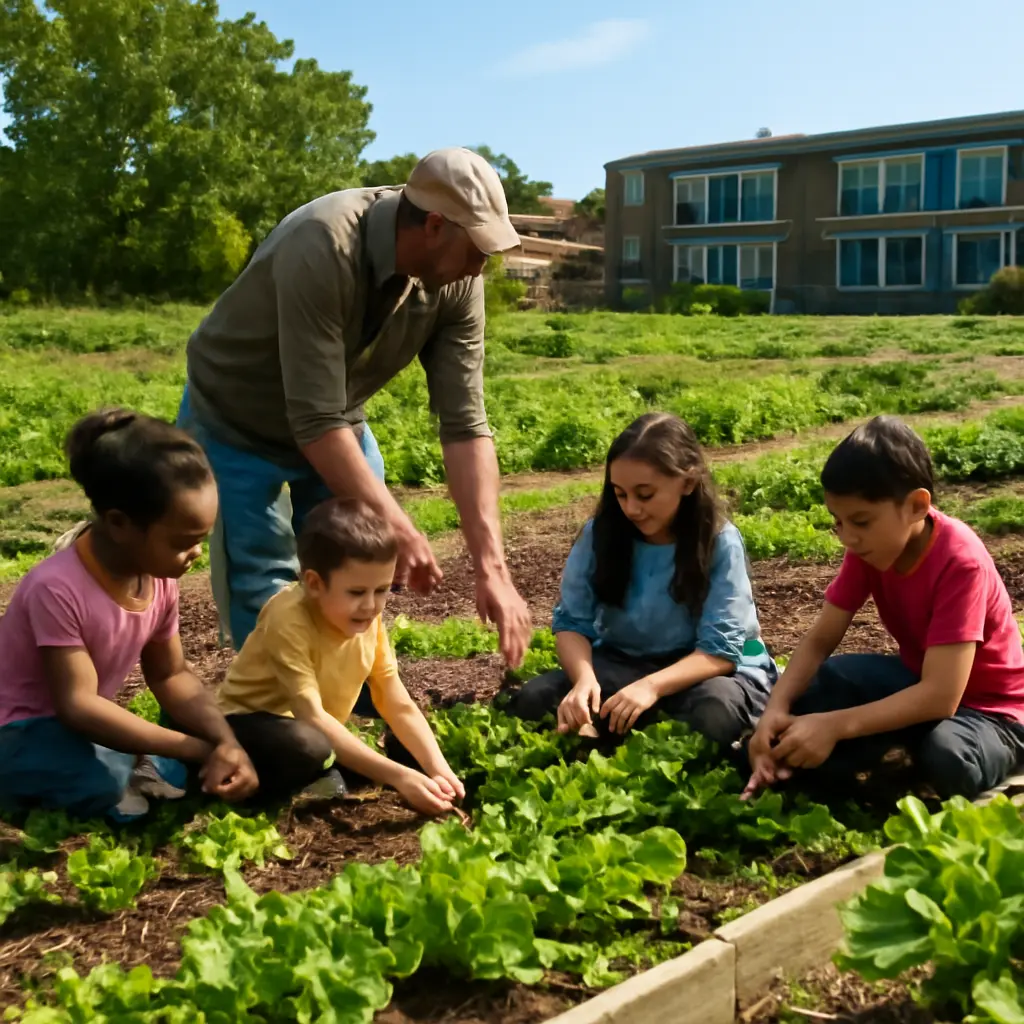
When children help grow vegetables, herbs, or fruit they later eat, gardening can turn healthy eating into a hands-on habit rather than a lecture. School and community garden studies associate participation with greater willingness to taste vegetables and increased fruit and vegetable intake, although results vary and gardening alone does not guarantee lasting change. Pairing child-led growing with cooking, repeated tasting, and supportive family or school meals gives children practical food skills while connecting garden participation to nutrition, confidence, and environmental learning.
Growing food strengthens children’s food habits
A “grow what you eat” approach is an educational practice in which children take part in planting, caring for, harvesting, and preparing edible plants. The U.S. Department of Agriculture’s Food and Nutrition Service describes school gardens as settings for experiential learning that can support nutrition education alongside science and other subjects. The approach matters because eating habits form early, while many children still have limited opportunities to learn where food comes from or to try unfamiliar produce in a low-pressure setting.
The Centers for Disease Control and Prevention (CDC) recommends that children ages 2–18 consume 1–2 cups of fruit and 1–3 cups of vegetables daily, depending on age and energy needs. Yet national dietary data show that children’s intake often falls short of recommendations, particularly for vegetables. Gardening can help address that gap by making produce familiar and giving children a meaningful role in choosing and preparing it. It works best as one part of a broader food environment that includes accessible healthy meals, adult encouragement, and repeated chances to taste.
Hands-on gardening connects food learning with eating behavior
The key attribute of food-growing education is direct participation: children do not only hear about nutritious foods; they experience the steps that bring them to the table. The National Farm to School Network defines farm-to-school programming broadly as connecting children to food, agriculture, and their communities through activities such as gardens, food education, and local food procurement. In a garden, that connection may include observing plant growth, harvesting produce, and tasting the result.
A 2017 systematic review and meta-analysis in the Journal of the Academy of Nutrition and Dietetics examined school gardening interventions and found evidence of improved vegetable intake, though the studies differed in design and effect. The review supports a measured conclusion: gardens can contribute to healthier food behaviors, but outcomes depend on how programs are taught, how long they run, and whether tasting and food preparation are included. Related forms of the approach include school gardens, home container gardens, community plots, and farm-to-school programs.
Planting and caring for crops builds food familiarity
Food familiarity is recognition and comfort with a food developed through repeated, positive exposure. When children sow seeds, water plants, and watch vegetables change over time, unfamiliar foods become recognizable. This does not mean every child will immediately like a newly harvested vegetable; it means the food has become part of an experience they understand, which can lower resistance to trying it.
The USDA’s Team Nutrition materials encourage schools to connect nutrition education with hands-on activities, including gardening and food preparation. A practical example is growing radishes or lettuce in a raised bed, then inviting children to inspect, wash, and sample the harvest. Short growing cycles can help sustain interest, while choosing crops suited to the local climate and season increases the chance that children will see the project succeed.
Harvesting and cooking turn interest into tasting opportunities
Harvest-to-table learning combines picking produce with preparing or serving it. Children might make a salad with garden greens, add herbs to a simple recipe, or compare raw and cooked vegetables. Cooking provides another route to engagement because children can handle ingredients, notice smells and textures, and see how a crop becomes part of a familiar dish.
Research reviews of garden-based nutrition education commonly identify tasting and food preparation as useful components, but they also note that program quality and measurement differ. For a fair test of whether a program changes eating, schools can track participation, the number of foods tasted, and plate waste or intake over time—not just whether children say they enjoyed the garden. A small, repeated tasting is often more constructive than pressuring a child to finish a serving.
Repeated exposure supports willingness to try vegetables
Repeated exposure means offering a food on multiple occasions without coercion. Children may need several opportunities to become comfortable with a new taste, and a garden can create those opportunities naturally: a child sees a plant grow, handles the harvest, helps prepare it, and encounters it again at meals. Gardening is therefore most useful when the produce returns to the classroom or family table rather than remaining a one-time activity.
A 2018 review in Appetite found that school gardening and related food education may improve children’s food knowledge and preferences, while evidence for sustained dietary change was less consistent. This distinction is important: liking a food or knowing how it grows is not the same as eating more of it over the long term. Continued access, adult modeling, and repeated tasting help bridge that gap.
Gardening can shape skills, confidence, and connection
Food-growing programs can support more than diet. They give children a concrete setting to practice responsibility, observation, cooperation, and patience. A garden also offers an accessible way to connect nutrition with biology, weather, soil, pollinators, and local food systems. These benefits are educational and social, and they should be understood alongside—not as substitutes for—evidence about what children actually eat.
Food skills and confidence grow through participation
Food skills include knowing how to select, handle, prepare, and enjoy foods. Children who help wash vegetables, tear lettuce, or mix a simple dish practice age-appropriate skills and gain a sense of ownership. The CDC identifies healthy eating as an important part of children’s growth and development; practical food skills can help make nutritious choices more familiar as children become more independent.
Programs should match tasks to age and ability, provide handwashing and tool-safety routines, and accommodate allergies and disabilities. Children can contribute in many ways, including labeling seedlings, observing growth, watering with adapted tools, or helping choose recipes. A successful garden is not defined by how much each child can dig, but by whether every child has a meaningful way to participate.
School gardens connect lessons with real-world food systems
A school garden is a growing space used for instruction, food education, or both. It can support lessons on plant life cycles and nutrition while helping children understand seasonal harvests and the work involved in producing food. Farm-to-school programs extend this connection through local food, farmer visits, and classroom learning.
The USDA’s Farm to School Census has documented participation by thousands of school food authorities in farm-to-school activities, including gardens and local food education. Such programs provide a real-world model for linking school meals and learning, but they require planning: schools need a dependable water source, suitable growing space, maintenance during breaks, and coordination with food-service staff. Partnerships with families, local growers, and community organizations can share that work.
Home and community gardens make the approach adaptable
Children do not need a large plot to grow edible plants. Containers, window boxes, or shared community beds can support herbs, leafy greens, or compact vegetables, provided the site has appropriate light, clean growing materials, and safe water. These options can make gardening more practical for families with limited outdoor space.
Community gardens also offer opportunities for intergenerational learning and cultural relevance. Families can grow foods they already enjoy, share recipes, and introduce children to ingredients connected to their traditions. That choice matters: a program is more inclusive when it respects different food cultures, avoids treating one cuisine as the default, and offers alternatives for children with dietary restrictions.
Effective programs pair growing with access and evaluation
A garden cannot by itself overcome food insecurity, limited meal choices, or unequal access to fresh produce. The CDC and USDA both emphasize broader settings and systems that make healthy foods available and support healthy choices. For that reason, growing projects should connect harvests to meals, nutrition education, and family or community resources wherever possible.
Inclusive design makes participation more equitable
Equitable garden education considers who has space, time, tools, transportation, and a voice in deciding what gets planted. Schools can reduce barriers by supplying materials, scheduling activities during the school day, offering accessible beds, and selecting crops that reflect students’ preferences and cultures. If produce is harvested at school, clear food-safety procedures should guide washing, storage, and serving.
The USDA’s National School Lunch Program and related nutrition initiatives offer a route to connect food education with meals, while community organizations can help sustain gardens beyond the academic year. These partnerships are especially valuable when families may not have space or resources to maintain a home garden. The goal is not to make children responsible for solving food-access problems, but to give them a positive, practical learning experience within a supportive system.
Evaluation distinguishes enthusiasm from lasting habit change
Program evaluation asks whether a garden achieves its intended outcomes. Useful measures include attendance, gardening and cooking skills, willingness to taste, food knowledge, and produce consumption. Collecting observations before and after a program—and, where possible, checking again later—can show whether changes persist.
Reports should avoid claiming that a garden caused a dietary improvement when other factors may have contributed, such as changes in school menus or family food access. A simple chart could compare the share of participating children who taste a target vegetable at the start, end, and follow-up of a program. Reporting the number of participants and how the measure was collected makes the result more useful and transparent.
Conclusion: let children grow, prepare, and enjoy their food
Growing food with children can connect food familiarity, repeated tasting, cooking skills, and school or community learning. Research suggests these programs can improve food knowledge and willingness to try produce, while long-term changes in eating are less certain and depend on continued access and support. The strongest approach makes gardening inclusive, links harvests to meals, and evaluates both participation and actual food behavior.
Families, educators, and community leaders can begin with one suitable crop, invite children to help choose and care for it, and plan how the harvest will be prepared and shared. For further guidance, consult USDA Team Nutrition resources, CDC child nutrition recommendations, and local cooperative extension or farm-to-school organizations. When children have a real role in growing and enjoying food, healthy habits become something they can practice—not just something adults ask them to do.
Sources: Centers for Disease Control and Prevention, “Childhood Nutrition Facts,” https://www.cdc.gov/school-health/conditions/chronic/childhood-nutrition-facts.html; U.S. Department of Agriculture Food and Nutrition Service, “School Gardens,” https://www.fns.usda.gov/cn/school-gardens; National Farm to School Network, “About,” https://www.farmtoschool.org/about; Ohly, H. et al., “A systematic review of the health and well-being impacts of school gardening: synthesis of quantitative and qualitative evidence,” Journal of the Academy of Nutrition and Dietetics, 2016, https://doi.org/10.1016/j.jand.2016.01.010; Savoie-Roskos, M. R., Wengreen, H., and Durward, C., “Increasing fruit and vegetable intake among children and youth through gardening-based interventions: a systematic review,” Journal of the Academy of Nutrition and Dietetics, 2017, https://doi.org/10.1016/j.jand.2016.10.014; USDA Food and Nutrition Service, “Farm to School Census,” https://www.fns.usda.gov/f2s/farm-school-census.